How to choose a liquid filling machine
Published 16 November 2026 · Updated 16 November 2026
Quick answer
Choose a filler by the real product, container, target quantity and required output. Confirm the proposed configuration with samples and written trial criteria, then compare quotations with the same equipment and service scope.
A useful filler shortlist starts with the product and container, then the required output. The number of nozzles alone does not establish suitability. Prepare a short specification that every supplier can answer against the same samples and acceptance criteria.
Start with the product, not the machine name
- Identify the liquid or paste, its filling temperature and whether it contains particles. Describe viscosity at that temperature; a product name such as sauce is not a complete specification.
- Record foaming, dripping or stringing during a trial pour. Provide the relevant product handling information so wetted parts, seals and the filling method can be assessed.
- List every container: material, shape, neck opening, dimensions and target quantity. Send representative bottles and caps, including the smallest and largest formats.
Separate a measured quantity from a visible fill level. A volumetric filler meters a volume; an overflow filler targets a consistent fill height. Which result matters to your package must be clear before comparing machines.
Compare published examples against your application
These existing catalog entries illustrate different starting points. They are examples to discuss with the team, rather than interchangeable machines or a promise that one configuration suits every formulation.
| Product example | Published direction | What to confirm |
|---|---|---|
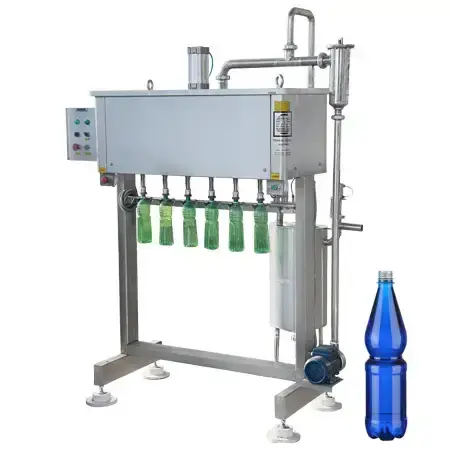
| Semi-Automatic Thin Liquid Filler 6 Nozzles | Semi-automatic overflow filling for thin liquids in PET bottles. | Your liquid, bottle neck and required fill result. |
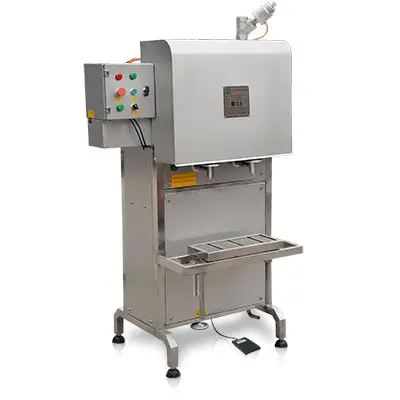
| Semi-Automatic Two-Nozzle Viscous Liquid Filler | Semi-automatic two-nozzle filling for viscous products. | Trial with the actual product and container; operator handling. |
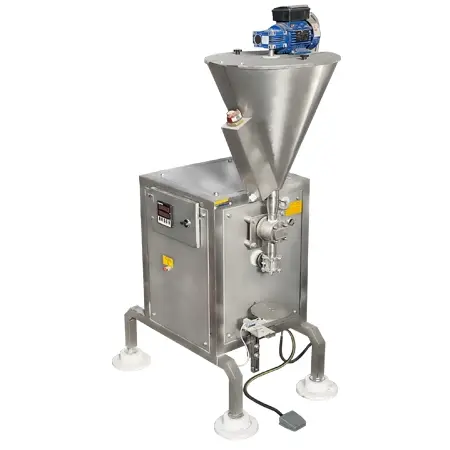
| Semi-Automatic Gravimetric Gear-Pump Filler | A gravimetric gear-pump configuration with a heated, mixed tank. | Required filling quantity, product temperature and the quoted configuration. |
Start from the liquid and paste filling catalog to compare the actual specification sheets. A listed body material does not, by itself, confirm the compatibility of every product-contact part.
Specify usable output and a complete line
State the number of acceptable filled containers you need per hour for each container size. If the target is 2400 containers per hour, that is 40 per minute before allowing for stops; this is a planning example, not a machine rating.
Discuss how bottles arrive, how caps are applied and how filled containers leave. A fast filler cannot deliver the intended line output when loading, capping or downstream handling is the limiting step. Ask how product changeovers, container changes and cleaning affect the production schedule.
Agree how a filling trial will be judged
- Identify the product batch, temperature, fill setting and container format used in the trial.
- Agree the sampling method and acceptable quantity variation for that project. Ask for the measured results rather than relying on a general accuracy slogan.
- Observe nozzle dripping, foam, splashing and container handling as well as the filled quantity.
- Record changeover and cleaning steps, operator tasks and the equipment needed for them.
- Keep the accepted configuration, sample results and any open points with the quotation.
Check the site and the quotation scope
Provide the site power supply, available compressed air, installation space, access route and required conveyor interfaces. Request the utilities and layout for the proposed configuration; do not size the site from a different model in the catalog.
Compare quotations for the same scope: filling equipment, product-contact components, tank or transfer equipment, container handling, format parts, documentation, commissioning and training. Ask which items are included and which are separate. Final specifications, price validity, payment, manufacturing and delivery dates, transport, customs, installation, training, warranty and spare parts are defined in the quotation and contract for each project.
Send a brief that can produce a useful quotation
- Product and filling temperature; any particles, foaming or special handling.
- Container and cap samples, dimensions and all target fill quantities.
- Required acceptable output by format; manual or automatic handling preference.
- Available power, air and footprint; equipment already on the line.
- Delivery city and the requested supply and service scope.
Send these details to request a project quotation. For the next decisions, use the labeling-machine selection guide and the machinery ordering checklist.
Frequently asked questions
Does adding more nozzles always increase useful output?
No. Output also depends on the product, container size, filling cycle, loading and downstream equipment. Compare the complete proposed line under the same trial conditions.
Can one filler handle both thin liquids and thick pastes?
That depends on the filling system and the specific products. Provide samples and the full range of temperatures and quantities so suitability and changeover requirements can be assessed.
Is there one guaranteed filling accuracy for all machines?
No universal accuracy is stated here. Agree the acceptable quantity variation and sampling method for your product, container and proposed configuration in the project documents.
How do I obtain a price?
Send the product, container samples or drawings, fill quantities, required output, site utilities and delivery location. The quotation and contract define the final configuration, price and commercial terms.