How to choose a labeling machine for your containers
Published 16 November 2026 · Updated 16 November 2026
Quick answer
Match the labeling configuration to the container shape, label position and production roll. Test alignment, adhesion, changeovers and usable output with your real samples before confirming the machine scope.
Choose a labeling machine around the package surface and the finished label position. Begin with the actual container and a production label roll, then work back to the machine configuration. A round-bottle applicator, a front-and-back system and a top labeler address different packaging jobs.
Define the package and the label position
- Record the container material, dimensions and shape. Include any taper, handle, seam, recess or raised feature that affects the label area.
- Mark whether the label must wrap around the body, sit on one or two faces, or be applied to a top surface. State whether it must align with an existing feature.
- Provide filled and empty samples where handling differs, plus the smallest and largest formats in the planned range.
A cylindrical bottle and a flat-sided container need different handling to present the label area consistently. Do not extend a successful round-bottle test to every bottle shape without checking the other formats.
Match the application to real catalog options
| Application | Published example | Decision to verify |
|---|---|---|
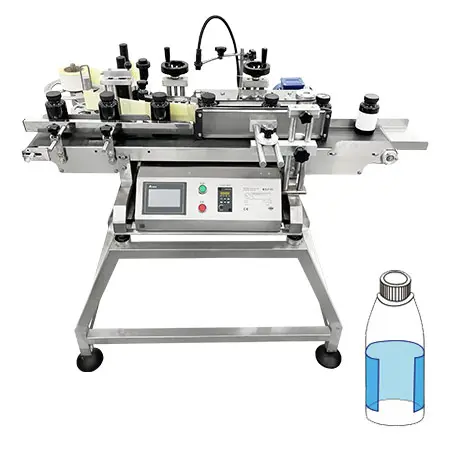
| Round containers | Automatic Round Bottle Labeler ELF-50 | Bottle dimensions, wrap position and the required output on your sample. |
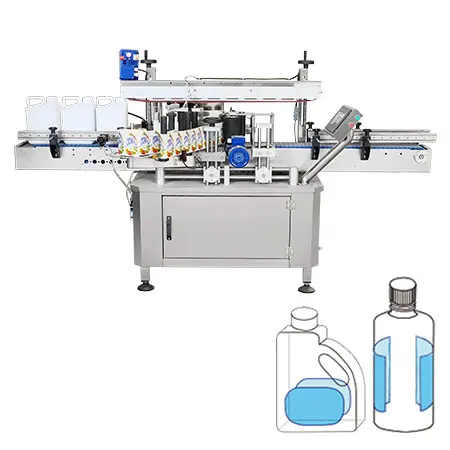
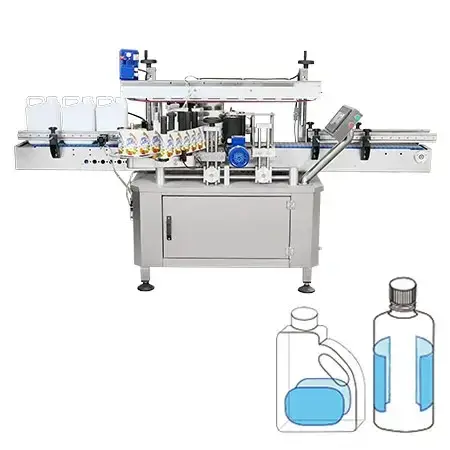
| Flat containers and round bottles | Fully Automatic Double-Sided and Round Labeling Machine | Required labeling stations and format parts. The published maximum label height is 15 cm; confirm all other dimensions for your roll. |
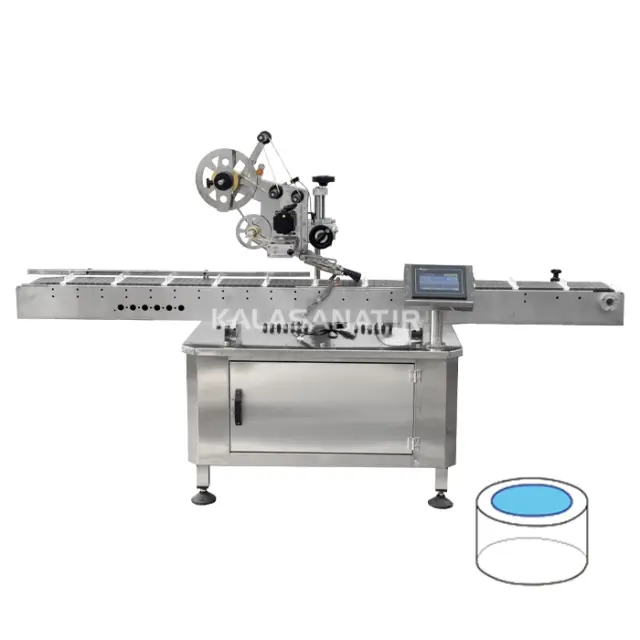
| Top surfaces | Top Flat Labeling Machine | Usable top area, package support and orientation on the conveyor. |
Browse the self-adhesive labeling catalog to compare those configurations. Product examples describe the published catalog; your quotation must identify the actual configuration being supplied.
Supply the label roll specification
Send the label width and length, gap, liner width, roll outside diameter, core diameter and unwind direction. Add a drawing or clear photograph showing how the printed label faces the applicator. These details should be confirmed with the proposed machine, rather than copied from another labeler.
Identify paper or film, opaque or transparent labels and any reflective areas. Ask how the container and label sensors will be verified with the actual materials. Test the printed information and label position as separate requirements.
Test appearance, adhesion and repeatability
- Agree the reference position and acceptable alignment variation on the real container.
- Run the actual label stock and adhesive on the intended package surface and under the relevant storage or handling conditions.
- Inspect skew, wrinkles, bubbles, lifting edges and any overlap or seam position that matters to the design.
- Repeat the run at the intended line output and during ordinary starts and stops.
- Change to another planned container format and record the adjustments and format parts required.
This trial should demonstrate the application you will use. It does not establish suitability for a different container, label material or operating condition that was not tested.
Plan the complete station
Specify the required number of acceptable labeled containers per hour, conveyor direction and height, available space and upstream and downstream equipment. Include product separation, container stabilization and any coding or inspection interfaces that are part of the project.
Compare the operator tasks for loading containers, changing rolls, setting a format and clearing a stop. Ask which spare or change parts are included. Final price, delivery, installation, training, warranty and parts support are set in the project quotation and contract; no universal package is assumed.
Prepare the request for quotation
- Container samples and dimensions for every planned format.
- Label artwork and a representative production roll with its technical specification.
- Required label position and the agreed appearance criteria.
- Output target, site utilities, conveyor interfaces and available footprint.
- Delivery location and the requested training and service scope.
Request a labeling-machine assessment with these details. If the station is part of a new line, also read the liquid-filler selection guide and the ordering process from specification to acceptance.
Frequently asked questions
Can a round-bottle labeler handle flat containers?
Do not assume this from a round-bottle demonstration. Flat or shaped containers may need a different handling and application configuration. Confirm the actual formats with samples.
What should I send besides a bottle?
Send the required label position, artwork, label and liner dimensions, roll and core diameters, unwind direction and a representative production roll.
Will transparent labels work with any sensor?
Compatibility must be confirmed for the proposed sensor and actual label material. Include transparent or reflective stock in the trial rather than assuming it behaves like opaque paper.
Does the 15 cm label-height example apply to every model?
No. It is the published maximum label height for the linked double-sided and round labeling machine. Confirm the dimension limits of the specific quoted model and configuration.